A few years ago, many companies viewed cryptocurrency as a niche trend. Today, it is increasingly becoming a mainstream payment option, especially for online businesses serving international customers. One reason is that traditional payment methods are often slower, more costly, and involve additional unnecessary steps.
Bank transfers can take several days to process. Card payments may involve transaction fees and chargeback risks, while international transactions often introduce additional complexity. As a result, many businesses have started exploring alternative payment methods, including cryptocurrency.
A crypto-fiat gateway enables companies to accept digital currencies without significantly changing their existing operations. Customers can pay using cryptocurrency, while the business receives fiat currency directly in its account. For many businesses, this provides a practical way to support modern payment options while minimizing additional operational risk.
At the same time, businesses researching how to set up a crypto payment gateway often find that the implementation process is less complicated than expected.
How Traditional Payment Methods Fall Short
Most business owners don’t think much about payment systems until something starts going wrong. Maybe international clients complain about transfer delays. Maybe processing fees become too high. Sometimes payments get blocked for no clear reason.
These issues are common, especially for online companies working globally. Traditional payment systems rely on several middlemen. Banks, processors, and financial institutions all take part in the transaction, which may slows down and increases costs.
Crypto payments work differently. Transactions move directly through blockchain networks, which removes part of the bureaucracy involved in regular transfers.
That doesn’t mean cryptocurrency replaces banking completely. In reality, most businesses simply use crypto as another payment option alongside cards and bank transfers.
What a Crypto Payment Gateway Actually Does
The technical side may sound complicated, but the process is actually quite straightforward.
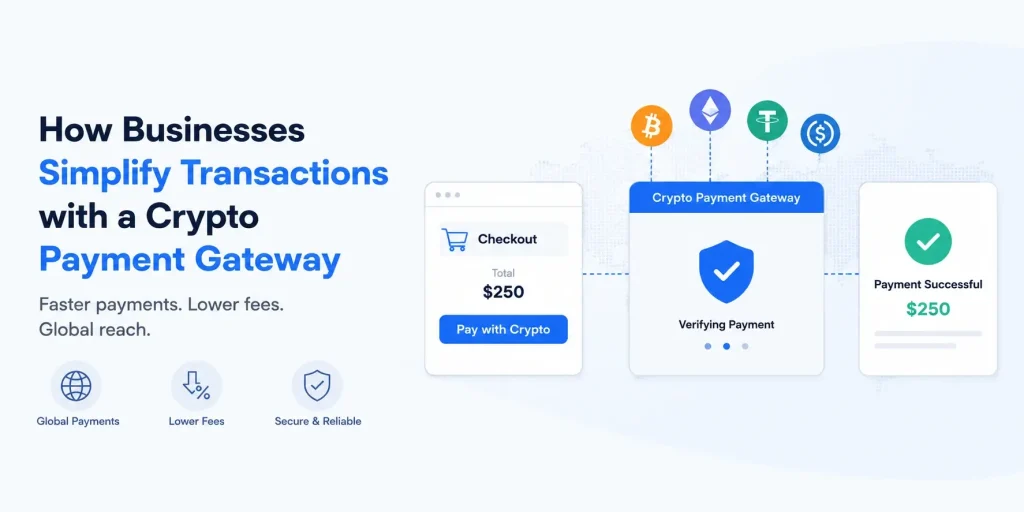
When a customer chooses crypto at checkout, the gateway creates a payment request. The customer sends the funds, the blockchain confirms the transaction, and the payment provider notifies the business that everything went through successfully.
Most modern gateways handle this automatically. Business owners don’t need to monitor wallets manually or understand blockchain coding. Good providers already offer dashboards, payment tracking, invoices, and integrations with popular e-commerce platforms.
Some systems also include automatic conversion. That means a customer can pay in Bitcoin, and the business receives dollars or euros instead. This is one of the reasons many companies prefer working with a crypto fiat gateway instead of holding cryptocurrency directly.
Lower Fees Matter More Than People Think
For many businesses, payment fees quietly consume a large portion of revenue.
Card processors charge a percentage on every transaction, while international payments often cost even more. When a company processes hundreds or thousands of payments each month, those costs become impossible to ignore.
Crypto payments can often reduce these expenses because fewer intermediaries are involved.
The difference may not seem significant at first, but over time it can noticeably improve profit margins, especially for online stores and digital service providers.
This is one of the main reasons companies start learning how to set up a crypto payment gateway in the first place. It’s not always about trends or technology. Sometimes, it’s simply about reducing costs.
Faster International Transactions
Businesses working with international customers know how frustrating global payments can be.
A transfer sent on Friday might not arrive until the middle of next week. Currency conversion creates another layer of delays and fees. In some regions, banking restrictions make transactions even harder.
Crypto payments help solve part of this problem because blockchain networks don’t really care where the sender or receiver is located.
In many cases, payments are confirmed within minutes instead of days.
For freelancers, SaaS platforms, agencies, and digital marketplaces, this speed can make everyday operations much easier.
Security and Chargeback Protection
Another reason businesses are becoming interested in crypto is security.
Traditional card payments can be reversed through chargebacks. Sometimes customers abuse this system, and businesses lose both the product and the money.
Blockchain transactions work differently. Once confirmed, they generally cannot be reversed without agreement from both sides.
That creates more predictability for merchants.
Of course, security still matters. Businesses should use trusted providers, enable two-factor authentication, and protect access to payment accounts properly.
But overall, crypto payments can reduce several common problems connected to online fraud.
How to Set Up a Crypto Payment Gateway
Setup procedure will vary from provider to provider, but is generally a similar process.
Firstly, a business selects a payment gateway that meets their requirements. There are services that are suitable for small online stores and others are more suitable for large companies or enterprise clients.
Once registration is completed, the gateway is then linked to the website or checkout system. The majority of the providers already have platforms such as Shopify or WooCommerce, so the installation is frequently straightforward.
Then it is up to the business to determine what to do with the incoming payments. There are businesses that hold onto cryptocurrency and those that automatically change everything to fiat.
If stability is preferred, automatic conversion is generally a better choice for businesses.
After all the components are hooked up, the company can run tests on transactions and begin to accept cryptocurrency payments from its customers.
Final Thoughts
The acceptance of Crypto payments is not exclusive to tech startups or blockchain companies. They are becoming more popular because they help to resolve genuine issues related to international transactions, processing charges and delayed payments.
This provides customers with greater flexibility, and it offers companies an additional payment option, one that is independent of traditional banking institutions.
Setting up a crypto payment gateway is not that hard as many business owners think. Most modern services are designed to work with the web and payment methods already in place, meaning there is a relatively easy integration.
For businesses seeking speedy transactions and reduced payment obstacles, incorporating crypto can be a sensible approach, not a passing fad.