Key Takeaways
- Built on Ethereum, ERC20 holds ~61% of on-chain RWA value, providing the deepest liquidity and institutional-grade DeFi composability for issuing tokenized assets.
- Built on TRON, TRC20 moves nearly 40% of global USDT volume with sub-cent transaction fees and ~3-second settlement times.
- Leading institutional RWA deployments don’t choose between standards. They issue the security/fund as an ERC20 token and settle transactions on TRC20 rails.
Every tokenized real world asset needs a token standard to exist on-chain. A token standard is the contract rulebook that defines how a tokenized asset is issued, transferred, and read by wallets and exchanges.
Whether you are minting a tokenized treasury bill, a private credit fund, or a property title, that asset lives inside a standard, moves through the wallets that support it, and trades in the liquidity that surrounds it.
Choose the right standard and your asset reaches buyers and settles cheaply. Choose the wrong one and you strand it on a network without demand or burn your margin on fees.
TRC20 and ERC20 are the two token standards most RWA tokenization teams compare first. ERC20 runs on Ethereum, the home of BlackRock’s BUIDL, Ondo, and most tokenized funds and treasuries. TRC20 runs on TRON, the network that settles close to half of all USDT and moves dollars for under a cent.
For institutional builders, the question is not which token standard is better overall, but rather, which one should issue the asset and which should move the cash.
Why RWA Tokenization Demand Is Surging in 2026
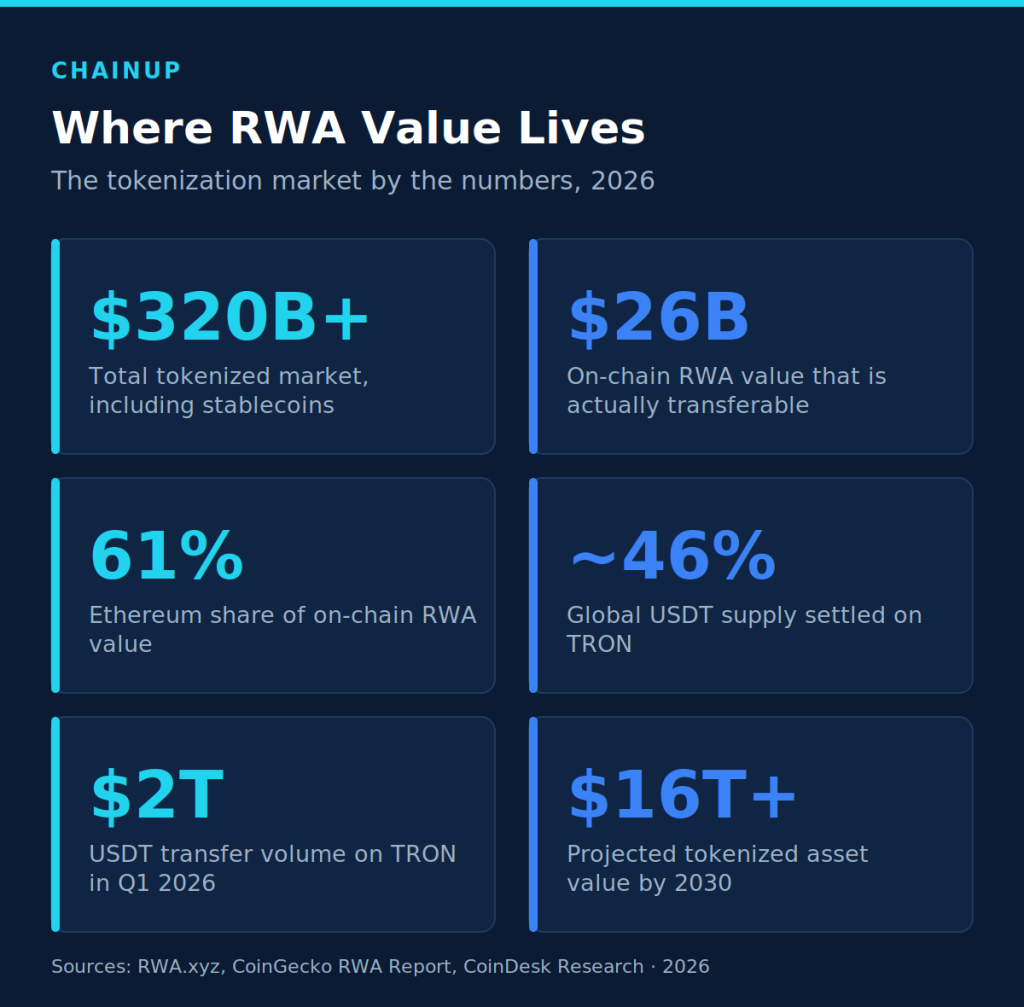
RWA tokenization moved from pilot to production in 2026, which raised the stakes on every infrastructure choice. On-chain RWAs passed $26 billion in transferable value by mid 2026, and the wider tokenized market including stablecoins now sits above $320 billion.
Tokenized RWAs excluding stablecoins grew 256 percent over fifteen months, from $5.42 billion in January 2025 to $19.32 billion by March 2026. Six asset categories each crossed $1 billion, including private credit, commodities, US Treasuries, and corporate bonds.
The buyers are no longer crypto natives experimenting at the edges. They are the largest names in finance, and three forces pulled them in.
Regulation arrived first, with the GENIUS Act establishing a US framework for stablecoins in 2025 and the anticipated Clarity Act expected to remove more barriers in 2026.
Institutions followed, as Franklin Templeton, JPMorgan, Fidelity, and Apollo launched or expanded tokenized products and the NYSE announced a venue for around the clock trading of tokenized securities.
Infrastructure matured last, with Japan’s Osaka Digital Exchange running a regulated secondary market for security tokens under the FIEA. For builders, this means the chain and standard you pick now will carry real institutional volume, not test transactions.
What are TRC20 and ERC20
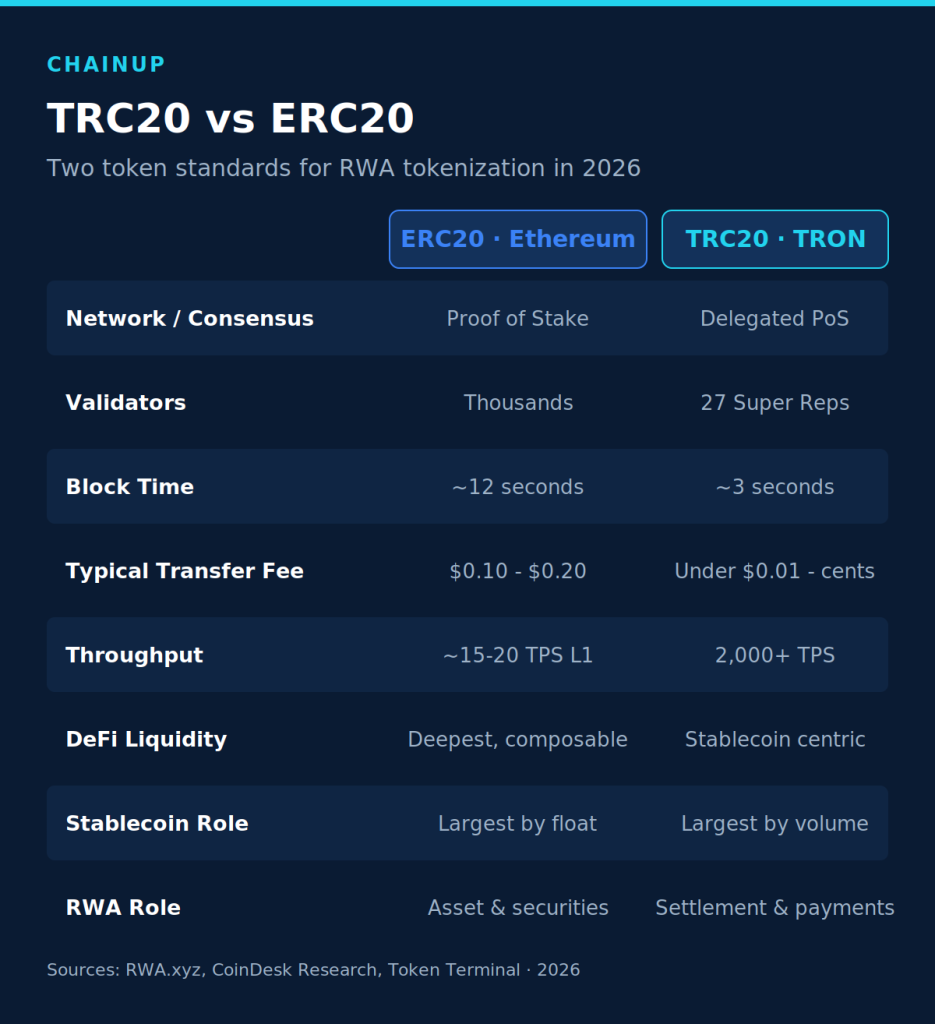
The two standards split cleanly by job, and the comparison below maps the differences that affect a tokenization deployment.
In short, ERC20 offers about 12 second blocks, mainnet fees near $0.10 to $0.20, and the deepest DeFi liquidity, which suits the asset itself.
TRC20 offers about 3 second blocks, sub-cent fees, and more than 2,000 transactions per second, which suits settlement.
Ethereum leads stablecoins by float while TRON leads by transfer volume, and that division of labor shapes every decision that follows.
Cost and Speed Favor TRON for Settlement
Settlement cost decides whether a tokenized product is profitable at scale. An ERC20 transfer on Ethereum mainnet runs about $0.10 to $0.20 and confirms in roughly 12 seconds.
A TRC20 transfer on TRON confirms in about 3 seconds, holds fees under a cent for users who stake network resources, and sustains more than 2,000 transactions per second. That gap is structural, not seasonal, because TRON uses a bandwidth and energy model that keeps costs flat even during volume spikes.
The math changes by transaction type. For the primary issuance of a high value fund, gas is a rounding error and Ethereum’s cost is irrelevant. For coupon payments, daily redemptions, and cross border payouts, fees compound into the whole margin.
This is why TRON moved close to $2 trillion in USDT transfer volume in the first quarter of 2026 and processed $7.9 trillion across 2025.
TRON also captured more than 40 percent of crypto shopping volume in Africa and Latin America, which makes TRC20 the natural rail for distributing tokenized value into emerging markets.
Liquidity and Composability Favor Ethereum
Liquidity is where ERC20 leads for serious RWA work. Ethereum holds about 61 percent of on-chain RWA value and leads tokenized funds and commodities, so an ERC20 asset plugs directly into Aave, Uniswap, and established stablecoin markets without leaving its network.
Issuers like BlackRock, Ondo, Circle, and Securitize chose Ethereum for exactly this reason, and each new tokenized asset deepens the liquidity that attracts the next one.
Composability is the part TRON cannot match. An ERC20 token can serve as collateral in a lending market, trade in an automated market maker, and settle in a stablecoin within the same transaction flow.
Permissioned ERC20 variants add whitelisting, transfer limits, and KYC while keeping that composability intact, which is why institutions can meet compliance rules without abandoning Ethereum.
TRON’s DeFi footprint is narrower, centered on SunSwap and JustLend, and its own RWA product stUSDT stays small next to Ethereum’s. If your asset needs secondary trading, lending, or yield through liquidity networks, ERC20 gives it a market on day one.
How Multi-Chain Deployment Changed the Calculus
The single chain question is fading because issuers now deploy the same asset across several networks.
Ethereum’s share of on-chain RWA market cap fell from 93.4 percent to 61.1 percent in roughly a year, not because Ethereum weakened but because issuers added chains to cut cost and widen reach.
BNB Chain surged from 0.1 percent to 20 percent after Circle deployed USYC there in late 2025. Solana grew its RWA market cap tenfold to about $1 billion as it pivoted toward institutions.
The lesson for a tokenization team is that token standard choice is now a portfolio decision. You can mint the institutional asset on Ethereum for liquidity, mirror it on a lower cost chain for retail distribution, and settle the cash leg on TRON where the stablecoin depth already exists.
Cross-chain bridging and consistent smart contract development make this practical, and dedicated RWA chains like Plume have struggled precisely because general purpose chains with existing liquidity hold the advantage.
Security, Decentralization, and Compliance Fit
Both standards now operate under the 2026 rules that followed the GENIUS Act framework for stablecoins. Ethereum runs Proof of Stake across thousands of validators, which gives ERC20 broad decentralization and a long institutional track record.
TRON runs Delegated Proof of Stake across 27 super representatives, which trades some decentralization for speed and low cost. Neither model is disqualifying for RWAs, but the heavier the institutional mandate, the more Ethereum’s validator depth matters.
Compliance lives mostly at the issuer level rather than the chain level. Permissioned ERC20 token standards let issuers enforce whitelisting and transfer restrictions while keeping institutional digital asset custody and audit support.
On TRON, the Tether and TRON joint T3 unit has frozen wallets tied to illicit flows, affecting only about 0.16 percent of TRC20 USDT. On either chain, robust KYT and AML screening protects your product more than the standard you pick.
Wallet and Exchange Support for Each Standard
Distribution depends on where your token can actually land, so wallet and exchange support matters as much as raw performance.
ERC20 enjoys universal coverage across MetaMask, Trust Wallet, and Coinbase Wallet, plus native listing on nearly every centralized and decentralized exchange. That reach is why a new ERC20 RWA can go to market quickly with broad accessibility.
TRC20 holders typically use TronLink or other TRON compatible wallets, though support has widened sharply.
MetaMask added native TRON support in 2026, and exchanges default to TRC20 for USDT withdrawals because it is the cheapest and fastest rail.
ERC20 maximizes interoperability for the asset itself, while TRC20 maximizes reach for the dollars that move around it through familiar wallet infrastructure.
Common Mistakes When Choosing a Token Standard for RWAs
Most token standard errors come from treating the choice as a one time decision instead of an architecture. The list below covers the mistakes that cost teams the most.
- Picking TRON for the asset layer to save on fees, then discovering the tokenized fund has no secondary liquidity or lending market.
- Issuing only on Ethereum mainnet, then watching emerging market users abandon redemptions because gas is higher than their transaction.
- Treating compliance as a chain feature rather than an issuer responsibility, which leaves whitelisting and screening as an afterthought.
- Ignoring multi-chain demand and locking the asset to one network, which caps distribution before the product even launches.
Which Standard Fits Your Tokenization Model
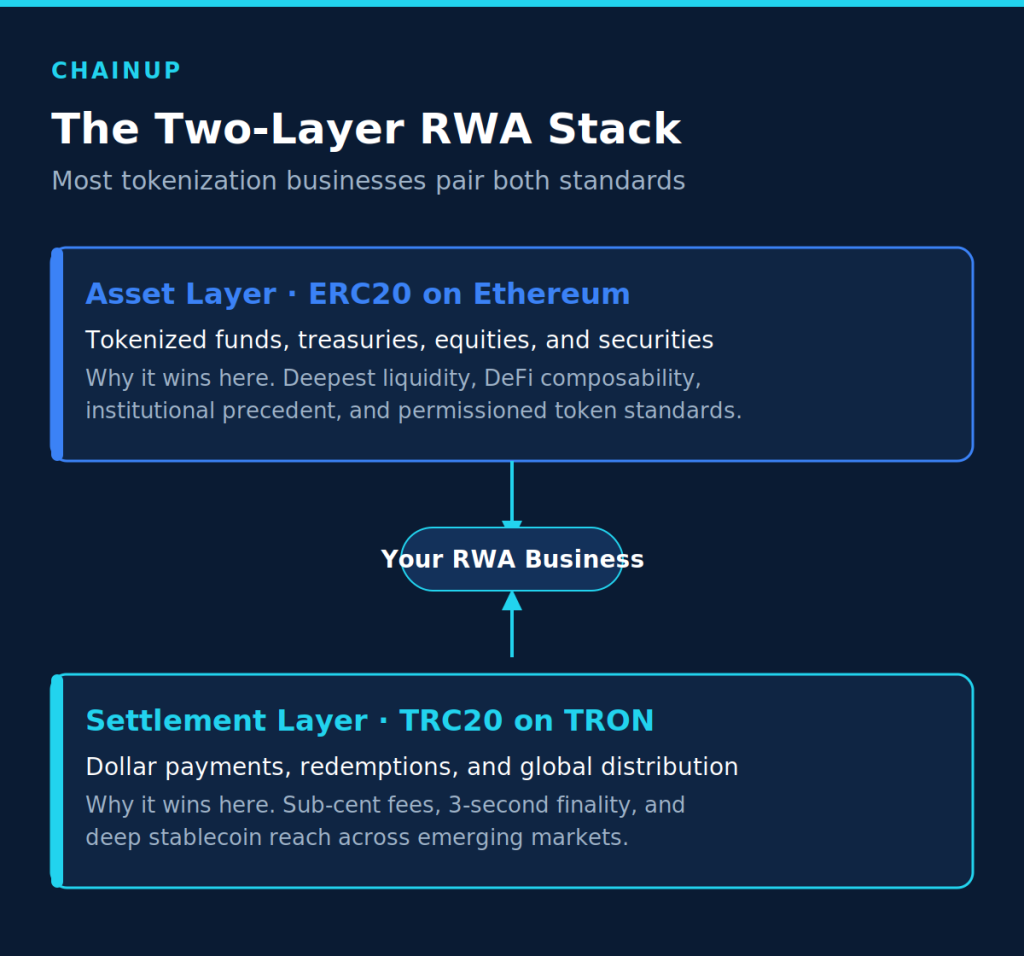
This is not a winner take all decision. The strongest 2026 RWA stacks run ERC20 and TRC20 as two layers with different jobs. Use this split as a starting point.
- Use ERC20 for the asset layer when you issue tokenized funds, treasuries, equities, or securities that need liquidity, DeFi composability, and institutional trust.
- Use TRC20 for the settlement layer when you need fast, cheap dollar movement for payouts and distribution into markets where USDT on TRON is already the default.
- Use both when your product spans issuance and high frequency settlement, connected through compliant bridging and shared infrastructure.
A tokenized money market fund shows the pattern clearly. You issue the fund as a permissioned ERC20 token so it can trade and serve as collateral across Ethereum DeFi. You then let investors subscribe and redeem in USDT on TRON, where settlement is near instant and nearly free. The asset and the money live on the standards that serve each best.
Build Your Complete Tokenization Architecture with ChainUp
Choosing between ERC20 and TRC20 is ultimately an architectural decision about where your value is created, traded, and settled. ERC20 delivers liquidity, institutional trust, and DeFi composability. TRC20 delivers speed, low transaction costs, and global payment distribution.
However, a token standard is only as effective as the infrastructure built around it.
ChainUp provides the end-to-end blockchain infrastructure required to launch, manage, and scale real-world asset tokenization:
- Smart Contract & Token Issuance: Securely mint custom ERC20 and TRC20 compliance-ready tokens.
- Institutional Custody: Protect digital assets with multi-party computation (MPC) security and granular permissioning.
- Cross-Chain Settlement & Liquidity: Move liquidity seamlessly between asset layers and settlement rails.
- Built-In Compliance: Automated KYT/AML transaction monitoring and identity management built directly into your platform.
Connecting these through a single stack lets you generate value from a tokenized asset across its full lifecycle rather than stitching together separate vendors for each piece. Talk to our team to map the right token standard and the infrastructure to run it, end to end, for your RWA tokenization model.